


Hi friends. This is Part 18 of my deep dive into the shallow waters of breast cancer. I am sharing these reflections from the past with the hope of being helpful to others. Please share at will. You will find all of my writing about cancer populated here in Substack: Stories From the Cancer Trail: A Breast Cancer Retrospective.
Until I was diagnosed with Invasive Ductal Carcinoma, I never guessed there were so many variations of cancer or that there were so many ways to evaluate and test for it. Some of these tests sound like the same word. Genetic and genomic, for example, are two very different kinds of tests that sound very similar.
Genetic testing is conducted when looking for any predisposition our elders may have passed along to us through our genes, by way of mutations like BRCA1 and BRCA2. I wrote about this for Wildfire Magazine last year in my article Postcards from Sicily. Even though my Grandma Rose had breast cancer before she died, thankfully I did not inherit any increased risk of it from her or anyone else in my gene pool, confirmed by the Invitae test of 155 different genes.

My first appointment with the oncologist was to talk about the other G: genomic testing, and to learn if I needed chemotherapy or would be moving directly to radiation. It would be my first of many appointments I was destined to have in that department and I was not looking forward to it. As you can guess, I left no Google Tab unturned as I sifted through the research ahead of time for clues on how this visit would transpire. Filling my brain to the rim with questions, preconceived notions and a pinch of sass isn’t always the best approach to a first encounter with an oncologist, I’ve learned.
Being my doctor can be tough.
To be fair, an oncologist isn’t an obstetrician. It’s not like they have a cheerful disposition because of the bundles of joy they bring into the world. Nope. An oncologist delivers all the bad, bad stuff. They tell you how much poison it’ll take to kill your cancer while almost killing you. They tell you about the life altering side effects of prescriptions you should expect. They tell you all of the things you don’t want to hear. There are no rainbows and unicorns in a room like this. But still, we must go.
While I think I hide it fairly well, I’m sure my oncologist could tell by the detail in my questions that I had done my homework. As a patient, it’s my job to advocate for myself. As the doctor it's her job to make sure I don’t shoot myself in the foot. That’s how this is supposed to work, right?
Genomic testing looks at our genes for their reaction or interaction with a particular cancer. For me, two tests were performed: the Ki-67 Proliferation Index and an Oncotype test. Both measure the activity of the cancer cells to gauge how effective chemo would be at prolonging someone’s life.
The Ki-67 test has been used to determine how fast tumor cells are dividing. By looking for the protein Ki-67, tumors are scored to indicate who may benefit more from having chemotherapy than they would without it. The higher amount of this protein detected in a tumor, the more division that is occurring. More division: bring on the chemo.
The Ki-67 results range from 0% to 100%. A score over 20% can be considered high, depending on several other variables, according to the Young Survivors Coalition.
My Ki-67 score was 11%.
The Oncotype test is another genomic test that analyzes 21 different genes within a cancer to gauge the likelihood of recurrence and what treatment options should be considered. This test is also used when it’s iffy that chemo would be more of a benefit than not. It’s not a test that everyone with breast cancer would be given, for sure. A cancer’s hormone reception, its stage and type; those are all factors to determine if it would be beneficial to get an “Onco-score” at all. The score tells a different story depending on the age of the patient. On a scale of 1 through 100, the lower the score, the less likely cancer will recur and the less likely chemo would be recommended.
According to BreastCancer.org Research News:
For women age 50 and younger:
Recurrence Score of 0-15: The cancer has a low risk of recurrence. The benefits of chemotherapy likely will not outweigh the risks of side effects.
Recurrence Score of 16-20: The cancer has a low to medium risk of recurrence. The benefits of chemotherapy likely will not outweigh the risks of side effects.
Recurrence Score of 21-25: The cancer has a medium risk of recurrence. The benefits of chemotherapy are likely to be greater than the risks of side effects.
Recurrence Score of 26-100: The cancer has a high risk of recurrence. The benefits of chemotherapy are likely to be greater than the risks of side effects.
My Onco-score was 14.
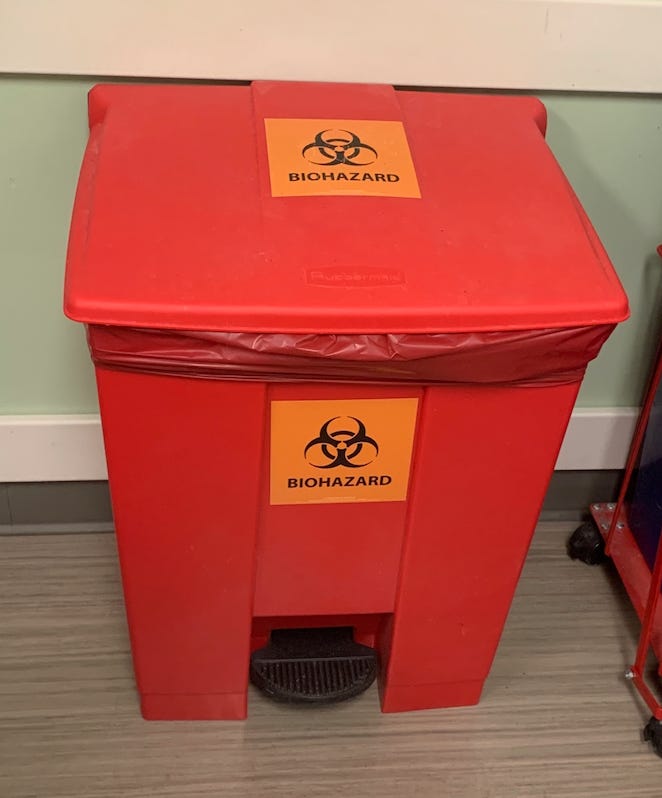
What I found peculiar was that the tests were performed the day my cancer was removed, presumably while it was “on the outside.” I don’t know why I assumed it was ejected from my body, chucked into the BioHazard bin and expeditiously buried in an unmarked grave in no man's land. No, they took their time with it. My cancer meatball, AKA Rat Bastard, may have been alive out in the world, living its best life somewhere in the San Fernando Valley, long after it had been removed. Maybe it still is. I s’pose, like those warehouses with boxes of evidence from cold cases, there might be a warehouse full of cancer. Cancer in jars. Cancer on Shelves. Remnants of people’s insides are just sitting together waiting to be useful or worse, scheming to join forces and take over the world.
Since both genomic tests indicated a very low risk of my cancer recurring or growing at any intensity in order to warrant chemo, my oncologist graduated me on to radiology for my next phase of treatment. There would be no poison in the veins prescribed. Instead, laser beams. Once my stint with radiation was complete, my oncologist and I would rendezvous to explore endocrine therapy, something I was also dreading.
I can’t be too pouty when news is “less bad” than it could have been, right? Even in an Oncologist appointment where the whole experience is crummy, a bright side can sometimes appear.
Less bad is totally good!